The Matter of Code

The matterMateriaof codekodu

Look at the code - the source text of any program, as a type of material.

See the effects of the code as a material manifestation.

Read the manifesto Browse the catalogue

The idea

The connecting thread of Wiesław Bartkowski’s work is the concept of “the matter of code” (Materia Kodu), which he coined, and the manifesto built on it, in which he breaks down the boundaries between art, design, science and technology in an anti-disciplinary way.

“The Matter of Code” is both a concept and the title of an exhibition presented at the Gdynia Design Days 2019 festival, in the edition themed Polarisation. The exhibition was curated by Wiesław Bartkowski.

Manifesto

The Matter of Code

“The Matter of Code” is a story about the Creative Coding practice that eliminates the polarisation of code and matter. It is a story of a “material” that has unique properties, a combination of physical and digital matter that does not produce a simple sum. Its emergent properties allow the creation of a unique experience, something that to designers and artists is otherwise unattainable. This “material” gives way to the creation of complex spatial installations that react to stimuli from the environment, changing the experience of space, its perceptions, and subsequently affecting human emotions.

The contact of the digital and physical world has been dominated by the interaction with intermediary screens whose flat surfaces have limited the sensory experience - our understanding of the world is based on motion, action, active and bodily experience. Screens cause the observation and manipulation of symbols, that remove the person from reality. As a result any richness of touch is lost, as the hand’s natural and sophisticated ability to manipulate the object is evaded.

Screens have created a distance from the environment that has shaped us, destroying the work of evolution that through hundreds of thousands of years has adapted both the mind and body to the ever changing environment. However, the combination of the possibilities offered by programming, electronics and digital fabrication, will allow us to boldly overcome the barrier of the screen - as a “material” that can “blend bits and atoms” emerges.

The space around us will be filled with physical artefacts of digital properties that cannot be passed by indifferently. These objects will engage us with a multi-sensory experience that encourages interaction that acts in accordance to how the world, physically and kinetically, is experienced.

Every designer, artist or architect can use this “material” in his creative workshop, without the need of a degree in technology as the barrier of entry has dropped intensely. The simplification of digital technology, open source and open hardware movements, DIY (Do-It-Yourself) culture, and the development of IDE (Integrated Development Environment) for creative coding has allowed everyone of desire to master this material through experience - in the same way as a sculptor learning to shape wood, stone or clay.

This exhibition shows how Creative Coding crosses the boundaries between art, design and science. Further emphasising its presence in many areas of creation. The Creative Coding practice is a call to start thinking in an anti-disciplinary way, to forget about the stereotypical divisions between the humanistic and scientific mind and change the passive recipients of technology into its active creators. Readers become writers. In the words of Douglas Rushkoff, “Program or be programmed”, get access to the civilisation control panel, gain a voice in the discussion about our future.

At the heart of our approach to Creative Coding is the permission to create something that is not needed. Accidental wandering and openness to error leads to a wonderful surprise and a creative discovery. We are convinced that this approach gives the chance to create something groundbreaking. Hack the way technology is used, find unexplored areas of code usage and explore seemingly impossible connections at the junction of the physical and digital world.

The exhibition “The Matter of Code” has collected a number of works that are just such an exploration, a beginning of numerous artists and designers from Poland and abroad. As well as the best projects of the graduates of the second year of Creative Coding postgraduate studies.

Wiesław Bartkowski
Wiesław Bartkowski, curator of the exhibition

Online catalogue

12 works where bits meet atoms

Works by artists and designers from Poland and abroad, as well as the best projects of the graduates of the second year of Creative Coding postgraduate studies at SWPS University.

  1. 01Forbidden Fruit Machine
  2. 02Useless Machine
  3. 03Beholder
  4. 04RotoRing
  5. 05Acoustic Additive Synth
  6. 06The Voice From The Towers
  7. 07Urban Echo
  8. 08Meet up, heat up
  9. 09Tanganyika: Al-Khwārizmī, Burton, Assange
  10. 10Cracow’s Bread
  11. 11Blob
  12. 12Up-art’A
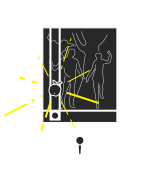
Illustration of Forbidden Fruit Machine

Work 01 / 12

Forbidden Fruit Machine

Kati Hyyppä, Niklas Roy

  • Move the joystick
  • Press the button
  • Take control over the forbidden fruit

The Forbidden Fruit Machine is based on a painting called “The Fall of Man” created by Cornelis Cornelisz van Haarlem in 1592. The painting depicts Eve and Adam in the Garden of Eden, being tempted by the serpent to eat the forbidden fruit. When Cornelis made his masterpiece, oil paintings were the hi-tech medium of the time. They featured incredible detail and ultra high resolution. Some 400 years later Kati Hyyppä and Niklas Roy decided to turn Cornelis’ artwork into today’s equivalent top-notch medium, namely, a mechatronic video game.

The most essential add-on to Cornelis’ painting is a joystick with which the spectator can take over the destiny of the forbidden fruit. By moving the apple around on a biblical quest, the player can discover exciting special effects hidden in the picture.

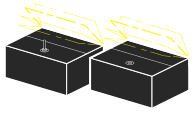
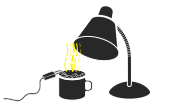
Illustration of Useless Machine

Work 02 / 12

Useless Machine

Karol Nowak

  • Switch the switch
  • Touch the button

A Useless Machine is a device that has a function but no direct purpose. It may be intended to make a philosophical point, as an amusing engineering “hack”, or as an intellectual joke. Devices that have no function or that malfunction are not considered to be “useless machines”.

The most well-known “useless machines” are those inspired by MIT professor and artificial intelligence pioneer Marvin Minsky’s design, in which the device’s sole function is to switch itself off by operating its own “off” switch.

Karol’s interpretation of Marvin Minsky’s design adds reflections on the flattening of contemporary interactions with devices. Once, sensually rich interactions now become dominated by screens and smooth, flat, touchable but sensually poor surfaces.

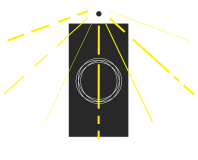
Illustration of Beholder

Work 03 / 12

Beholder

Jakub Koźniewski, Wojciech Stokowiec

  • Look into the eye of the mirror
  • Wait to be evaluated

Imagine a situation where you do not judge a work of art, but the work of art is judging you. This is exactly what happens when you stand in front of the Beholder, a machine enhanced by machine learning seen as a subset of artificial intelligence.

Beholder was trained according to the aesthetic sense of its creators. The device evaluates the beauty of people interacting with the work on a scale of 1 to 5. By the presented work, the authors ask questions that matter today: is it possible to make objective algorithms? Or maybe a machine only reflects the preferences and prejudices of its creators, known as data bias?

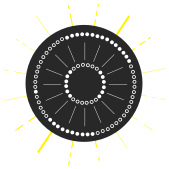
Illustration of RotoRing

Work 04 / 12

RotoRing

Gregory Kogos

  • Rotate the knob and press the button
  • Get to an empty spot
  • Avoid the red lights

RotoRing is a circular puzzle-platformer where you use a custom hardware controller. Its display is made out of 2 orbits of LED lights. You use the dial to control the single brightest light and use the button to jump from one orbit to another. The goal is to get to an empty spot while avoiding the red lights!

It’s a fully hardware game – there is no computer inside nor screen. There’s just an Arduino (a microcontroller) inside, 90 LED lights, button and knob. Though the author of RotoRing is not a coder, he managed to make this thing work all by himself.

RotoRing as Alternative Game Controller (alt.ctrl) was shown at ALT.CTRL.GDC San Francisco 2017, the world’s largest professional game industry event. Moreover, RotoRing won the award for best game design at the Tokyo Game Show.

Illustration of Acoustic Additive Synth

Work 05 / 12

Acoustic Additive Synth

Krzysztof Cybulski

  • Sing or speak into the microphone
  • Listen to your voice played back by the pipe organ

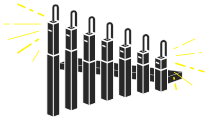
Acoustic Additive Synthesiser is another trial to create a fully acoustic device that could resynthesise any sound by the means of Fourier analysis and resynthesis, thus utilising basic principles of spectral music in realtime. It is in fact a small pipe organ, with pitch and volume controlled by a computer. Each of the seven pipes has a motorised slider, which changes the pitch continuously, and a dedicated motorised air valve, which effectively changes the volume of the sound. As the sound of the organ pipes is very close to a sinusoid, this setup, together with a purpose-written Pure Data patch, allows for resynthesis of voice or the creation of quasi-synthetic sounds. Alternatively, the instrument may be used as a regular pipe organ, but with the ability to play glissandos or any off-the-12TET microtonal pitches.

The presented work received an Honorary Mention at Prix Ars Electronica 2017 and reached the semifinal of the Guthman Instrument Competition, 2016.

Illustration of The Voice From The Towers

Work 06 / 12

The Voice From The Towers

Michał Sęk

  • Bring your ear close to the picture
  • Listen to the voice from the towers

The Voice From The Towers is a generative installation honoring the 9/11 victims and is made from their last phone calls. On 9/11/2001, people trapped above the impact point could contact the outside world only through a phone call. Some of them called their loved ones, but all they heard was the sound of an answering machine. We designed a generative sound-to-image installation turning the last phone calls of six 9/11 victims into visuals symbolic of the Twin Towers.

We wanted to pay them a tribute and make sure their stories will live on in a very intimate way. Each visual is unique, made with a generative code and silkscreen printed. Each voice can be heard only by getting close to the installation. Designed for the togetherness of the listener and the sound. The voice doesn’t exist without the listener.

The presented work won the gold award KTR 2019 in the best of design category. KTR is the largest creativity competition in Poland.

Illustration of Urban Echo

Work 07 / 12

Urban Echo

Klem Jankiewicz

  • Sing or speak into the microphone
  • Hear the echo
  • Listen to your voice be decomposed and reconstructed in space

Urban Echo is an interactive installation exploring our relationship with technology.

A swarm of electronic objects decomposes human voice and reconstructs it in space. Our unique voice turns into the voice of the swarm.

It is also an anti-black-box statement. All of the carefully designed electronic components, usually hidden inside plastic shells, are used as a form and visual identity of the objects.

Urban Echo was part of a theater play Roja, written and directed by Monika Popiel for Teatr Powszechny in Warsaw, and was also exhibited during World Maker Faire in New York.

Illustration of Meet up, heat up

Work 08 / 12

Meet up, heat up

Gosia Nierodzińska

  • Touch the porcelain cover
  • Encourage others to do the same
  • Face each other until you feel the heat

This is a code-controlled city furnace. It resembles a brazier covered with a porcelain lid - a quote from a domestic furnace. When at least two people touch it, the furnace heats up. If one person goes away, the temperature drops.

Meet up, heat up is an attempt to create an “infinite place: open, unfinished, difficult to define, because its main feature is to be open to the unexpected” (after Encore Heureux). In the face of the challenges of our time, we need to maintain hope and attempt to get closer to one another. We need neo-shamanic bonfires, common rituals and places of safe closeness. I wish that meet up, heat up can become such a place, a common ritual. It’s meant to be an inspirational experiment, ephemeral, but nonetheless concrete, based on solidarity and closeness in the face of the ubiquitous winter.

Illustration of Tanganyika: Al-Khwārizmī, Burton, Assange

Work 09 / 12

Tanganyika: Al-Khwārizmī, Burton, Assange

Paweł Janicki

  • Enter the address scratched on the table
  • Turn on the sound in your device and watch what happens

This impressive, interpassive installation was created especially for the “The Matter of Code” exhibition. It is a synthesis of several threads. History leading to the recent arrest of Julian Assange – founder of WikiLeaks. Some elements of the biography of Richard Francis Burton - freethinker, orientalist, linguist and swordsman, the first European who reached Lake Tanganyika, translator of the Arabian Nights into European languages and author of the original poetic text of The Kasîdah of Hâjî Abdû El-Yezdî, written under the pseudonym Hâjî Abdû El-Yezdî. And finally, the scientific achievements of Muhammad ibn Musa al-Khwarizmi, the Persian mathematician from whose name the word algorithm comes.

The installation approaches functioning in isolation, in contrast to the mainstream and social status quo (and even the social gag imposed on individuality) as well as communication discontinuity, but also the possibility of silent mutual understanding over cultural and semiotic barriers.

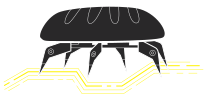
Illustration of Cracow’s Bread

Work 10 / 12

Cracow’s Bread

Janek Simon

  • Observe the crawling bread-robot
  • Do not touch it
  • Do not eat it
  • Oh yes! You can take a selfie

Cracow’s Bread is an attempt to check where the limits of homemade robotics lie. How far you can get by producing advanced technology objects by yourself. This is one of the artist’s series of works that were intended to prove that many objects produced by corporations can be created by yourself, thus making yourself independent of the socio-economic system.

It is also a manifestation of the artist’s interest in unstructured cognitive activity, like the creative damaging of objects by children. By creating absurd mechanisms, he reminds us of the absurd around us. Generates nonsense, in which the nonsense of everyday life looks like in the mirror. We experience such an absurdity by looking at the moving Cracow bread-robot, technologically advanced (for the time when it was created in 2006), a bizarre object without a function.

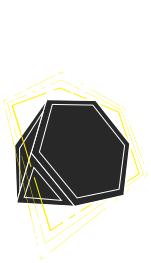
Illustration of Blob

Work 11 / 12

Blob

Martyna Chojnacka

  • Bring the earphone close to your ear
  • Listen to the music reshaping the Blob

Blob is an audioreactive, geometric creation that changes its shape under the influence of sounds, physically representing them. Blob is a visualisation transferred from the screen to the physical world. The combination of sounds, shapes and motion with the help of technology, engages senses, provokes to focus, explore and be in the situation here and now. The sculpture can fulfil various functions of data visualisation. Currently the author deals mainly with audioreaction and uses Blob in live performances.

Blob’s replicas with altered geometry and dimensions played in theatrical performances.

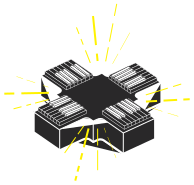
Illustration of Up-art’A

Work 12 / 12

Up-art’A

Arkadiusz Klej

  • Try to play on each side of the piano
  • Experience different types of AI

Up-art’A allows you to experience different types of relationships with artificial intelligence (AI). Learning to play the piano has been used to metaphorically look at possible paths of AI development, which are represented by the four sides of the instrument.

Do you want to stop AI development? The “Reversion” side acts as a normal piano. Or maybe the machine should allow you to make only the right decisions? The “Protector AI” side allows you to press only the right keys. In a perfect world, machines strengthen our potential. The “Enhanced AI” side is the only one aiming at our development, teaching how to play, with it we can achieve more. But do applications on your phone develop your skills? Will the machine or its creator make such a decision to develop us? The “Superintelligence” side is completely uninterested in us, realising its own agenda.

Up-art’A was developed as a semester project at the School of Ideas department of SWPS University.

Credits

The exhibition was prepared by

Curator
Wiesław Bartkowski
Producer
Klementyna Jankiewicz
Graphics and illustrations
Klara Jankiewicz
Design
Klementyna Jankiewicz, Yariv Ziv, Wiesław Bartkowski
Text correction
Tamara Olbrys, Aleksandra Janus
Implementation
Karol Nowak, Klementyna Jankiewicz, Yariv Ziv, Wiesław Bartkowski, Szymon Pepliński

Authors of the works

Martyna Chojnacka
antidisciplinary coder creating visual experiences from live generated animations to installations. A graduate of Creative Coding.
Krzysztof Cybulski
musician and sound artist, co-founder of new media art collective “panGenerator”.
Kati Hyyppä
artist and educator from Finland, who likes to explore playful ways to connect with technology.
Paweł Janicki
independent media artist and producer.
Klem Jankiewicz
designer. She uses design tools for creation, exploration, and learning. A graduate of Creative Coding.
Arkadiusz Klej
coordinator of cultural projects, student at the School of Ideas.
Gregory Kogos
game designer and artist from Ukraine.
Jakub Koźniewski
interaction designer, co-founder of new media art collective “panGenerator”.
Gosia Nierodzińska
Creative Strategist EMEA at Facebook. A graduate of Creative Coding.
Karol Nowak
landscape architect and designer. A graduate of Creative Coding.
Niklas Roy
installation artist and an educator from Berlin. He explores art, science and technology, often in the form of humorous installations and machines.
Michał Sęk
Senior Art Director at Saatchi & Saatchi. A graduate of Creative Coding.
Janek Simon
artist. Author of interactive installations, video films, objects and artistic actions.
Wojciech Stokowiec
Research Engineer at DeepMind.

Organisers and partners

  • Creative Coding
  • School of Form
  • Uniwersytet SWPS
  • Gdynia Design Days
  • Gdynia – moje miasto
  • PPNT Gdynia
  • Centrum Designu